GPT Image 2.5 (ChatGPT Images 2.5) AI Image Generator
GPT Image 2.5 is OpenAI's latest image generation and editing model family, officially released on September 8, 2026 (product name ChatGPT Images 2.5). It ships two API models — GPT Image 2.5 Flare (
gpt-image-2.5-flare) for speed and GPT Image 2.5 Sunburst (gpt-image-2.5-sunburst) for quality. Versus GPT Image 2 it delivers sharper details, more precise multi-turn editing, stronger subject preservation, native transparent backgrounds, custom output up to 4K, and generation latency reduced by up to 50%.
Use cases: Product Cutouts | Brand Logos | Fashion Campaigns | Infographics | UI Mockups | Multi-panel Comics | Exact In-image Text | Multi-turn Photo Edits
Try GPT Image 2.5 for Free Now
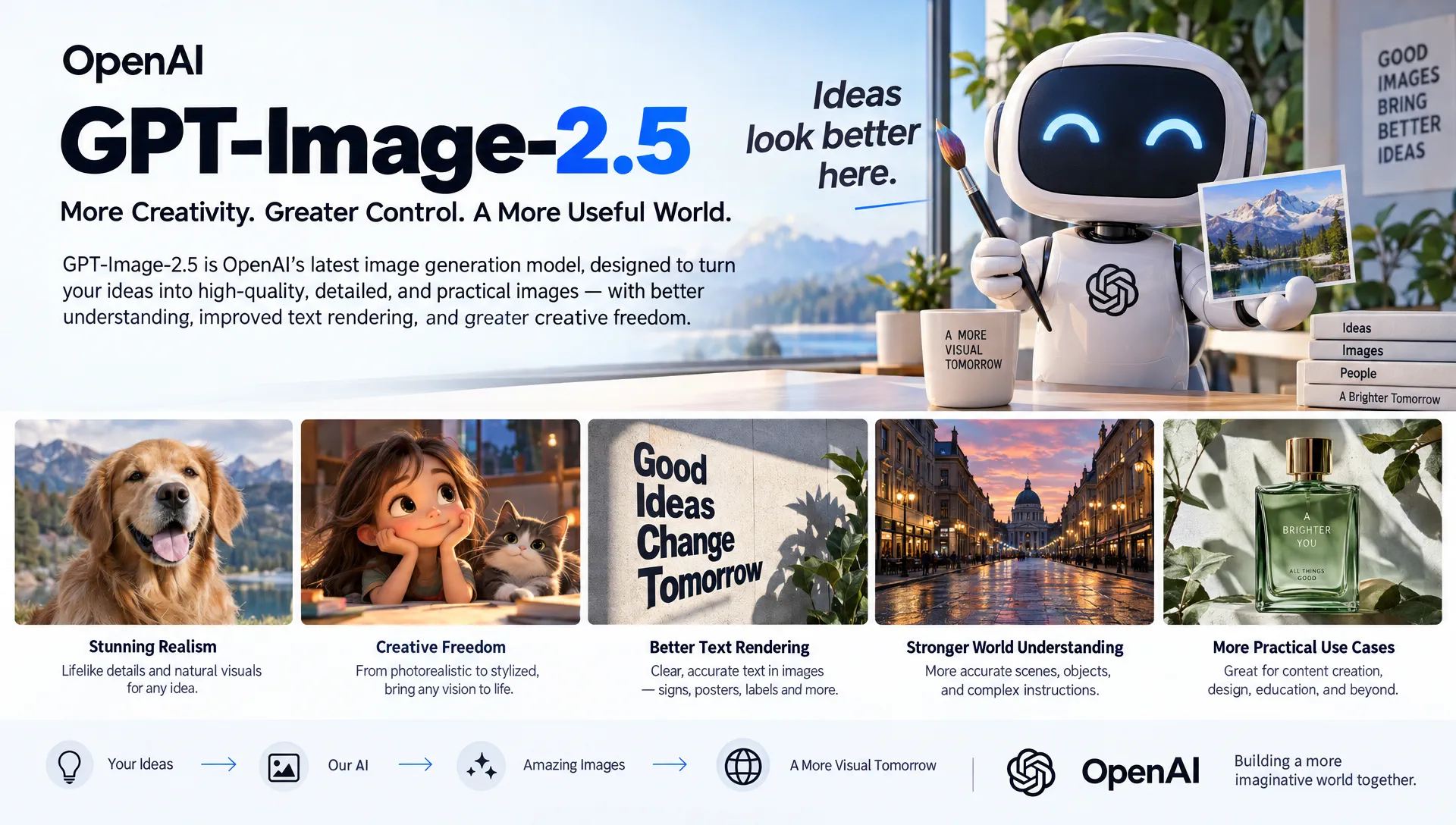
About GPT Image 2.5
GPT Image 2.5 is OpenAI's September 2026 multimodal image update. In ChatGPT the experience is branded ChatGPT Images 2.5. In the API it is two models with dated snapshots from September 8, 2026:
gpt-image-2.5-flare— the small, very fast model for everyday and high-volume generationgpt-image-2.5-sunburst— the base model for quality-first, precision editing workflows
OpenAI positions Images 2.5 around four upgrades over Images 2.0:
- Speed: generation latency reduced by up to 50%
- Fidelity: more natural lighting, richer textures, sharper fine detail
- Preservation: reference subjects, faces, products, and layouts stay more stable across edits
- Control: editing instructions follow more reliably turn after turn, including transparent assets
AIGCVA has integrated both gpt-image-2.5-flare and gpt-image-2.5-sunburst. No OpenAI account, no API key — open the AIGCVA App Center and start creating for free.
GPT Image 2.5 Core Features
⚡ Flare and Sunburst — Two Models, One Workflow
GPT Image 2.5 is not a single speed setting. It is two complementary models:
- Flare (speed): default choice for social posts, product drafts, visual search, rapid prototyping, and batch generation. Image quality is in the GPT Image 2 class, with much lower latency.
- Sunburst (quality): choose it when GPT Image 2 still falls short on complex layouts, identity lock, product geometry, or dense text. Generation takes longer; editing precision is the priority.
- Practical rule: draft on Flare; if identity, labels, or local edits still drift, switch the same prompt and references to Sunburst.
- Shared surface: both accept text and image inputs, support generation and editing, and share quality, size, and transparent-background controls.
🎯 Precise Multi-Turn Editing
Describe the change and list what must not move:
- Change only X: swap an outfit, translate labels, or replace a background without rewriting the whole frame
- Preserve identity: lock face, skin tone, hairstyle, pose, and body geometry while changing clothes or props
- Product lock: keep silhouette, materials, and label text intact across lifestyle shots
- Layout lock: translate infographic copy while keeping icons, arrows, and composition
- Iterate one step at a time: pass the previous output back in, request a single change, and restate the constraints
🪪 Subject Preservation from Reference Photos
Upload a person, product, garment, or scene and assign each image a role:
- Subject reference: keep the person or product recognizable
- Style reference: borrow palette, medium, or texture
- Clothing / prop reference: dress the subject without pasting artifacts
- Scene reference: place the subject into a new environment with matched lighting
- Best for: lookbooks, SKU series, character sheets, and campaign variants that must stay on-model
🪟 Native Transparent Backgrounds
GPT Image 2.5 natively outputs true alpha transparency — not a drawn checkerboard:
- Logos and marks: clean vector-like silhouettes with padding, ready for brand kits
- Product cutouts: isolate SKUs for e-commerce, stickers, and compositing
- Export: use PNG or WebP so the alpha channel survives; JPEG cannot store transparency
- Follow-up edits: restating “keep the transparent background” on every turn prevents a solid backdrop from coming back
✍️ Exact Text, Diagrams, and Interface Previews
GPT Image 2.5 is built for images that have to read, not just look good:
- Quoted copy: put required wording in quotes, say how many times it should appear, and ban extra text
- Infographics: process diagrams, biology handouts, and labeled flows with readable arrows
- Slides and charts: pitch-deck frames with real numbers, hierarchy, and footnotes
- UI mockups: app screens that look shipped — spacing, type, and components instead of concept-art chrome
- Comics: panel-by-panel beats with consistent characters and clear actions
🖼️ Custom Resolution up to 4K
Cover every channel without a separate upscaler:
- Common sizes: 1024×1024, 1536×1024, 1024×1536, 2048×2048 (2K square), 2048×1152 (2K landscape), 3840×2160 (4K landscape), 2160×3840 (4K portrait)
- Custom
WIDTHxHEIGHT: each edge a multiple of 16, no longer than 3840 px, aspect ratio within 3:1 - Quality ladder:
auto(default),low,medium,high,xhigh,max— raise quality for small text and dense diagrams; drop it once the look is accepted - Watermark-free export: outputs on AIGCVA are watermark-free and ready for commercial use within applicable terms
GPT Image 2.5 Flare vs Sunburst vs GPT Image 2
| Capability | GPT Image 2 | GPT Image 2.5 Flare | GPT Image 2.5 Sunburst |
|---|---|---|---|
| Official role | Previous-gen all-rounder | Speed / everyday volume | Quality / precise editing |
| API model | gpt-image-2 | gpt-image-2.5-flare | gpt-image-2.5-sunburst |
| Latency vs GPT Image 2 | Baseline | Up to 50% lower | Longer than Flare |
| Image quality | Strong | GPT Image 2 class, faster | Higher than GPT Image 2 |
| Multi-turn edit reliability | Good | Improved | Best |
| Reference subject lock | Good | Improved | Best |
| Transparent background | Limited | Native alpha | Native alpha |
| Quality settings | Standard | auto / low / medium / high / xhigh / max | auto / low / medium / high / xhigh / max |
| Max output | 2K native / 4K optional | Custom up to 4K (3840 px) | Custom up to 4K (3840 px) |
| Aspect ratio | 3:1 to 1:3 | 3:1, custom WxH | 3:1, custom WxH |
| Commercial use on AIGCVA | Watermark-free | Watermark-free | Watermark-free |
Official-Style Showcase Scenes
These are the workflows OpenAI highlights for GPT Image 2.5 — all available on AIGCVA:
🛍️ Transparent Product Cutout
Isolate a product on a true transparent background. Preserve geometry and label text, with clean alpha edges and no halo.
👕 Identity-Preserving Outfit Swap
Keep face, pose, and lighting; change only the garments from clothing references. Ideal for lookbooks and virtual try-on drafts.
📊 Infographic and Process Diagram
Explain a machine, a biological pathway, or a market slide with labeled parts, arrows, and readable type.
📱 App UI Mockup
Describe a real interface — header, list, hierarchy, type — so the result looks like a shipped screen, not a poster.
📚 Multi-Panel Comic
One vertical strip, one visual beat per panel, consistent characters, no leftover prompt text in the balloons.
GPT Image 2.5 Use Cases
📱 Advertising and Marketing
- Campaign key visuals, social posts, and merch mockups
- Streetwear and fashion ads with exact taglines
- Poster and flyer layouts with quoted headlines
🛍️ E-commerce and Product Visuals
- Transparent PNG cutouts for detail pages and ads
- Lifestyle shots that keep SKU geometry consistent
- Background swaps and canvas sizes for every marketplace
🎨 Brand and Visual Design
- Logo variations on transparent backgrounds
- Infographics, pitch slides, and educational diagrams
- Style transfer while locking composition
🎬 Content and Character Work
- Comic reels and storyboards
- Character-consistent scene changes
- Cover art, thumbnails, and UI concept frames
How to Use GPT Image 2.5 on AIGCVA
1. Open the AIGCVA App Center
Go to the AIGCVA App Center and select GPT Image 2.5 Flare or GPT Image 2.5 Sunburst.
2. Choose the Model
- Flare: first choice for speed, drafts, and volume
- Sunburst: switch here when the same prompt still misses identity, tiny text, or local edits
3. Write an Effective Prompt
Organize complex jobs as scene, subject, details, and constraints:
[Deliverable] + [Subject] + [Style / lighting] + [Composition] + [Quoted in-image text] + [What must not change]Example prompt:
A commercial product photograph of a matte glass serum bottle, three-quarter view,
soft window light from the left, gentle specular highlights on the glass,
pale stone surface, shallow depth of field.
Render the label text exactly once: "AURORA SERUM".
No extra text, no watermark, no logo besides the bottle label.
Photorealistic, natural materials, 2K, commercial photography
4. Upload Reference Images (optional)
- Number each input in the prompt: image 1 = subject, image 2 = style, image 3 = clothing
- Say what should move where, and what must stay identical
- Clear, well-lit references with a prominent subject lock more reliably
5. Tune Parameters
- Quality: start at
mediumorhigh; usexhigh/maxonly when small text or fine materials still fail - Size: pick a preset or a custom ratio within 3:1, up to 4K
- Background:
transparentfor logos, stickers, and cutouts; otherwiseopaque - Format: PNG or WebP when you need alpha
6. Iterate with Natural Language
Keep the last image as input and change one thing:
- "Change only the jacket to the cream trench from image 2. Do not change her face, hair, pose, or lighting."
- "Translate the infographic labels to Spanish. Do not change layout, icons, or colors."
- "Keep the transparent background. Tighten the silhouette. No drop shadow."
- "Same character as before, panel 3 only: she sits by the door as if nothing happened."
GPT Image 2.5 Prompt Optimization Tips
✅ Name the deliverable
- ❌ A nice picture of coffee
- ✅ A labeled infographic that shows how an automatic coffee machine flows from beans to cup, for a product manual
✅ Quote in-image text exactly once
- ❌ Some slogan on the poster
- ✅ Render the tagline "Yours to Create." exactly once, clearly, integrated into the layout. No extra text.
✅ Separate the edit from the lock list
- ❌ Make it better and keep it similar
- ✅ Change only the clothing. Do not change face, skin tone, body shape, pose, camera angle, or background.
✅ Assign a role to every reference
- ❌ Use these images
- ✅ Image 1 is the person to preserve. Image 2–4 are clothing only. Fit the garments to her existing pose.
✅ Raise quality for dense type, then step down
- Diagrams, slides, and small labels →
highor above - Simple portraits and style sketches →
mediumon Flare is usually enough
Frequently Asked Questions
What is GPT Image 2.5 best at?
Best at: product cutouts, logos on transparent backgrounds, identity-preserving fashion edits, infographics, UI mockups, comics, multilingual layout translation, e-commerce hero images, and brand series that must stay consistent across turns. Also strong at: photorealistic portraits, campaign photography, educational diagrams, and pitch-deck slides.
What is the difference between ChatGPT Images 2.5, Flare, and Sunburst?
ChatGPT Images 2.5 is OpenAI's consumer product name. gpt-image-2.5-flare and gpt-image-2.5-sunburst are the API model names. AIGCVA integrates both API models so you can pick speed or precision without an OpenAI account.
Can I use the generated images commercially?
Yes. Images generated on AIGCVA are watermark-free by default and may be used for commercial purposes within applicable terms. See the AIGCVA Terms of Service for license details.
Why did a detail I wanted to keep still change?
Restate the lock list every turn ("do not change face, label, lighting"). Edit one region at a time. If a patch must stay pixel-identical, composite the approved region back onto the original instead of relying on prompting alone. Switch to Sunburst when Flare still drifts.
Does a higher quality setting always look better?
No. OpenAI recommends choosing the model first, then testing quality one step at a time. xhigh and max help unmet text or material requirements; they do not guarantee a better image for every prompt and they increase latency.
GPT Image 2.5 Technical Advantages
- Dual-model lineup: Flare for throughput, Sunburst for precision — same prompt surface
- Lower latency: up to 50% faster generation versus GPT Image 2 on Flare
- Edit reliability: stronger instruction following across multi-turn refinements
- True transparency: native alpha for logos, stickers, and product isolation
- Production sizes: custom resolution up to 4K with a 3:1 aspect envelope
- Readable graphics: exact text, diagrams, slides, and UI frames in one model family
Get Started with GPT Image 2.5
No credit card, no API key — sign up and start creating with OpenAI's latest image models for free:
🎨 Try GPT Image 2.5 for Free Now
Related Resources
- Introducing ChatGPT Images 2.5 (OpenAI)
- GPT Image 2.5 prompting guide
- GPT Image 2.5 Flare model
- GPT Image 2.5 Sunburst model